Monday, May 27, 2013

Mountain Biking

Today our plan was to ride overland from Imabari to Matsuyama, home of the famous Dougo Onsen, the building that was the inspiration for the bathhouse in Miyazaki's "Spirited Away" as well as several of the henro temples (more on that in a moment). So, we were up early to get breakfast and get everything packed up so we could see a few sights in Imabari before making the 40km trek to Matsuyama. Breakfast was at a bakery in the station, which had a decent assortment of pastries and breads.
C'mon, you knew I couldn't resist. top tray, anpan, walnut bread and croissant.  Lower row croissant and "french pizza"
Before we left town, we wanted to see Imabari Castle, one of three "Castles on the Sea". Most Japanese castles were constructed on a peak or some other well defensible position. A few were built by the ocean, and Imabari was one of those. It was also just a few blocks from our hotel.

The castle itself was quite impressive, with its six story main building and numerous smaller outer buildings and a very large functional moat. Inside the main building was a very good museum with a huge collection of samurai armor (the biggest we've ever seen, including that at the National Museum in Ueno) and, from out of nowhere, a serious natural history section that included fossils, animals of the region and shells of local sea life among other things. It was a very nice collection that had absolutely nothing to do with the castle, but was a pleasant surprise.

Imabari Castle and....some guy on a horse.
Guy On a Horse
One of the shrines in the castle grounds
A view of the outer buildings from the top of the keep.
and a view of the moat. It is over 15' wide in parts and 10' deep
Unfortunately, like most museums in Japan, you aren't allowed to take any pictures of the displays
Um, Sumi, what are you doing with your phone?
After the castle, we went in search of one of the 88 Kukai-related temples in the area that pilgrims visit and pray at. Our choice: number 57, Eifukuji. It was a beautiful, smaller temple with no main gate.
Several pilgrims came to pray while we visited
Pilgrims strike this at the start of their prayer ceremony. Made me kind of want to be a pilgrim for a day. Or a few minutes, anyway.
Not at all sure what the frog on the table symbolizes, but I thought it looked cool.
Sumi has an ambition to be a henro, a Buddhist pilgrim. Of course, she's not Buddhist, but the idea of walking to all the temples and getting your book stamped sounds cool, right? Well, when she told me about this, I was picturing getting like a point card stamped (get a free sub after twelve purchased). I had no idea what the book and the stamp meant.
The book is a thing of beauty, a hardbound book with detailed sketches of each temple and some inscription related to it. The three stamps and calligraphy are added to a blank page across from the sketch by temple workers in front of you when you finish your visit, 
So, she only has 87 more to go! We'll probably visit a few more during the next week or so.

After Eifukuji, we were off to our next destination, Matsuyama. The henro guidebook suggested taking the road along the coast. We were going to do that, but looking on Google Maps showed it wasn't a very scenic ride and you didn't actually see the coast very much. So we chose to go inland through what looked like a pass between mountain peaks.

Silly us.

Hey, who put this mountain here?
It turned out to be 3.5 hours of climbing winding roads up a mountain on a road that often had little or no shoulder with frequent traffic. And that was just to get through the first 20km. It was a beautiful climb, though, that ran alongside a heavily dammed river with frequent tiered rice paddies.
tiered rice paddies. The water is piped from the river and flows back to the river.

A much smaller bridge, this time
Spectacular, even, but not much consolation as we slogged our way up the mountain, dragging our 50# trailers with us. It wouldn't have been so bad if there had been any kind of consistent shoulder, but portions had no shoulder and just a small guardrail between you and a 100' drop with cars passing you and regular intervals. And then came the tunnel
Yup, 2.8km of tunnel. Sumi's trying very hard to look happy about this.
Fortunately for us, the extremely long tunnel had a raised maintenance sidewalk! One wide enough for our trailers, to boot. So it was long and loud, but the trip through the tunnel, which we were quite dreading after the last few miles of dangerous roads, was almost relaxing. What followed was the whole reason we climbed this mountain in the first place. The ride down! In about one hour of near constant downhill, we covered 18 miles (with stops before two smaller tunnels and the occasional water break) and almost didn't pedal until we reaches Matsuyama and Dougo Onsen.
Cheap baths (¥360) and a lot of history. The oldest onsen in Japan
Our hotel, which is partnered with a Youth Hostel we stayed at in Miyajima, turned out to not only be a very nice hotel, but also right next door to the onsen. A prime location! We'll be here for the next day or two, checking out Matsuyama while the rain passes (coming in tonight, up to 3 inches by tomorrow night). Tonight we finally had a chance to go out to a real restaurant for dinner. After the mountain climb, we were exhausted and didn't want to go too far. Luckily there is an Italian restaurant in one of the almost 100 hotels around Dougo Onsen that was open and smelled too good to walk by without stopping in. The dining room was full, but outdoor seating was open and it was a perfect night.
Caprese! Freshest tomatoes I've had in a long time.
Fresh garlic bread!
Margarita Pizza
Spaghetti Napolitano. If you look carefully, you will see what look like small hot dogs. That's what passes for Italian Sausage here in Japan. They weren't quite hot dogs, but certainly weren't sausage.
Strawberry Shortcake. Sumi wasn't letting us leave without one

Ok, hope that makes up for the lack of food pics earlier on! Tomorrow we'll be visiting Matsuyama castle, if its not raining too badly, and probably Ishite temple, as well, so Sumi can get another page stamped. I'll leave you with a few images of the silliness that is Japan, at times.
Every city or area has a mascot. Ehime Prefecture has this guy: a baby chicken with a  bridge for a crown and a ferry under his right wing, is my closest guess. He's for sale all over. Sumi couldn't resist. He now rides with her, hanging from her handlebar bag.
Warning sign by one of the lakes made by the hydroelectric dams along the river we biked by.

Sunday, May 26, 2013

The Bridges of Hiroshima Prefecture

Up early this morning to pack up, assemble the bikes, hope everything works and hit the road. After much sweating, swearing and squashing we managed to get our bikes together, pack everything we brought, somehow, into our trailers and get out and on our way before 7:30. We were starting the trip by taking a ferry across a very narrow inlet to the first island of the day, Mukaishima. Honestly, we could have swam across the inlet, it was so narrow, but not with the bikes.


Reaching the other side, we started our trip on the Shimanami Kaido, a toll road that passes over six islands in a chain of small islands between the main island of Honshu and our destination, Shikoku. This chain of small islands is home mostly to fishermen and farmers, but also of some great scenery. Sub-tropic beaches along the Seto Inland Sea and mountains make for some pretty amazing vistas, most of which we didn't take pictures of, since se were busy biking :) But we did get some pictures of the bridges, which were pretty impressive themselves, and give a taste of the scenery.

Connecting the six islands of Mukaishima, Innoshima, Ikuchijima, Omishima, Hakatajimain and Oshima are five bridges, including the Kurushima-Kaikyo bridge (which is structurally three bridges, but it's all one long bridge path) that is the first three consecutive suspension bridge system in the world. It is over a mile long (4015m) and, if you are traveling to Imabari, is also mostly uphill. Just sayin'. Also  the Tatara bridge, one of the longest cable-stay bridges in the world (1480m) and has the border of Ehime and Hiroshima prefectures in the middle of the bridge. All the bridges were toll bridges and had separate lanes for bicycle, moped and foot traffic. The tolls were a very cheap 500¥ per bike for the entire trip. 

The first bridge, Innoshima, had a whole separate section UNDERNEATH the rest of the traffic for bikes and foot traffic!

A view of the Tatara bridge while approaching. Each bridge had an "on ramp" for the bikes that was about 1km long and all a spiraling uphill climb.

Hakata-Oshima Bridge. Note the sand beach on the sea. Most of Japan's coast to the Pacific is more rocky and severe.

Omishima Bridge. The smallest of the five.
We did take a detour while on Innoshima to check out the Pirate Castle (Suigun castle), which was the home base of the Murakami Pirates from the 14th to the 17th centuries. It boasted an active Buddhist temple and in-use Buddhist cemetery right next to it, and was pretty cool. When approaching one of the buildings, we heard a prayer service (think Buddhist chant) going on.
A view of the castle and outer building from the cemetery adjacent to it.

"Walk Of the Dead". A long path around the cemetery. Not sure what it signifies.
The rest of the day was spent pedaling, with occasional stops for pictures, all the way to Imabari, which was 73km from our starting point. This doesn't sound bad to cyclists, but add jet lag, constant up and down (often over 700m) and a 50# trailer draggin behind you, it was a pretty grueling first day out.

It reads "Beware of Animals". I didn't know we had wild boar in this area.

Palm trees and the ocean. Sumi approves.
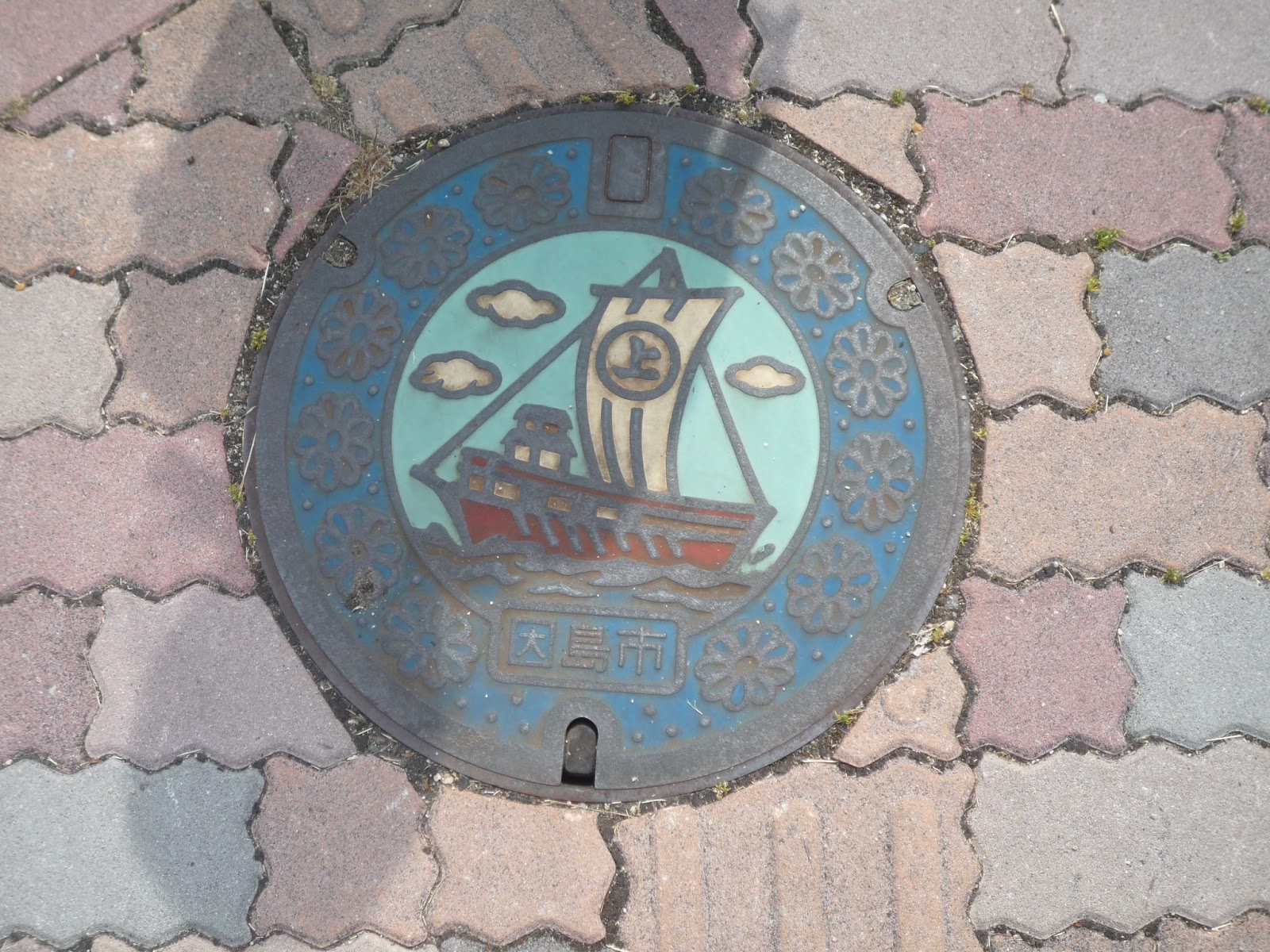
Some more manhole covers.


I love the shopping streets in Japan and Asia in general.

The entire Kaido has great signs and markers. We were quite spoiled.
After a 9.5 hour day pedaling away in the sun, we arrived at Imabari, a small city on the north end of Shikoku. We headed to the train station and checked in with the Information desk. The pleasant lady informed us there was just a big cycling event that had occurred this weekend (we had seen lots of cyclists and knew something was going on, but not what) and, as a result, all the cheap hotels were booked. She did find us a not cheap hotel that is amazing. The room is so big, we were able to fit everything inside (including our bikes AND trailers) and not be cramped. Luxurious by Japanese standards. So, a good night's sleep here and we'll be off for Matsuyama tomorrow, if we can move enough to get out of bed, that is :)

P.S. No food pics today. We ate pretty much road food (granola bars, bread, etc) and even had konbini dinner (yogurt, cabbage salad in a bag, bread, ham and egg sandwiches). We'll have a real meal tomorrow night in Matsuyama.

Saturday, May 25, 2013

Fukuyama and Onomichi

When we last left our intrepid heroes, they had a few hours to kill before they could check in to our overnight bus near Tokyo Station, so we headed to the station, dropped off our heavy backpacks in a locker and did a quick search of the area and found a bookstore we hadn't been to before, the Marunouchi Book Center. 


It was an impressive nine floors of books, including almost half a floor dedicated to various computer books. 
Um....ok....
After spending over an hour browsing, we grabbed some overnight rations at a nearby Lawson, grabbed our packs and headed to the bus stop to board the bus


The bus trip was uneventful, for the most part. It was a comfortable ride, mostly, though anyone my size would have trouble fitting in the seats, especially when the guy in front of you insists on reclining all the way back for the entire ten hours. We made several stops on the way at rest stops on the highway, which are some of the nicest, cleanest rest stops you'll ever find. A family of swallows agreed, and made a nest in the men's bathroom of one.

We arrived in Fukuyama, a town just northeast of our starting point, at 6:00am. Japan doesn't do mornings very well, so nothing, not even the train station, was open, except for a few 24 hour convenience stores. Every electronic device we had was now pretty much out of juice, and we needed a place to plug in, and after a night on a bus we also needed a shower, so, with our last remaining battery on our iPhone, we searched for an internet cafe. Nothing came up at all, but we did find a sentou (public bath) about a mile from the station. 

Fukuyama has a Rose festival every year, and the streets downtown were still covered in them. 


We also got to meet the town mascot. 
Lemme guess, her name is Rosie.

We located the sentou easily enough, but as the Japanese usually bath in the evening, it was also closed. Rather desperate, at this point, Sumi saw a Pachinko parlor called Cyber down the street, so we figured they may be open and may have an internet cafe inside. Well, we were wrong on both counts BUT 
Shh, don't tell anyone!
at least we got to sit down and charge our phones. 

Sumi found a real internet cafe on the other side of town, so with the train station now open we headed out in search of a shower and internet. Well, after about 40 minutes of walking, we found said internet cafe, but were informed it was "members only". What the apologetic young man was trying to say was that we needed to sign up like you would at an old fashioned video store to get membership and then could use the services. This, of course, requires a local address. He did, after some searching, give us a map with an onsen marked on it, but that would have been another few miles of walking with our increasingly heavy backpacks (they each weigh about 20 pounds) in the heat (it was already 80 degrees by 9:00am). So, we gave in and decided being filthy tourists was ok for now, and headed back downtown for some sightseeing.

We had until 2:00pm before we could check in to our hotel in Onomichi, so we threw our packs, which we were starting to detest, in a locker and headed across the street to Fukuyama Castle. 

Apparently, there is a sizable Christian population in Fukuyama. This is the large r of two churches, as viewed from the castle grounds

Important historical samurai whose name we could not read
It was quite a nice museum/park area with a restored castle (the original burned down at the end of WWII), some nice walkways and an nice old park, probably built in the 1950s when they restored the castle. 
This looks way too fun to be allowed in the US. Someone might scrap their knee.


I'm sorry ma'am, there is a height requirement for this ride.

With several hours still to burn, we grabbed some lunch at what can only be described as a Japanese Denny's. My omurice (omelet stuffed with rice) was passable and Sumi's caesar salad was fine, except for the impressively gelatinous boiled egg that was included. 

How do you even PEEL an egg that soft?
After lunch we figured we'd head to our hotel in Onomichi and see if we could check in a little early, so we hopped on the train to Onomichi.

Onomichi is a small, sprawling seaside town, with a castle of it's own. 

Heading to our hotel neat the station, we weren't allowed to check in early, but did get to drop off our bags. At this point we STILL had a few hours, so we took a walk along the river that runs through town (and empties into the ocean).


There is a local sculpture whose work is all over Fukuyama and Onomichi. He liked nude women so much that's all he did. This one inexplicably has peacocks, as well.
Finally 2:00pm rolled around and we were able to check in to our tiny room that could barely hold our luggage and us at the same time. A/C and a shower made everything much better. So much better, in fact, that we ended up taking a nap….a five hour nap. Waking up with that feeling that you know you slept too long, we blew our chance at assembling our bikes today, as the sun sets around 7pm. We resigned ourselves to doing laundry and getting ready for tomorrow morning. Setting the alarm for a painful-looking 4:00am and hoping we can get to sleep after the "nap".